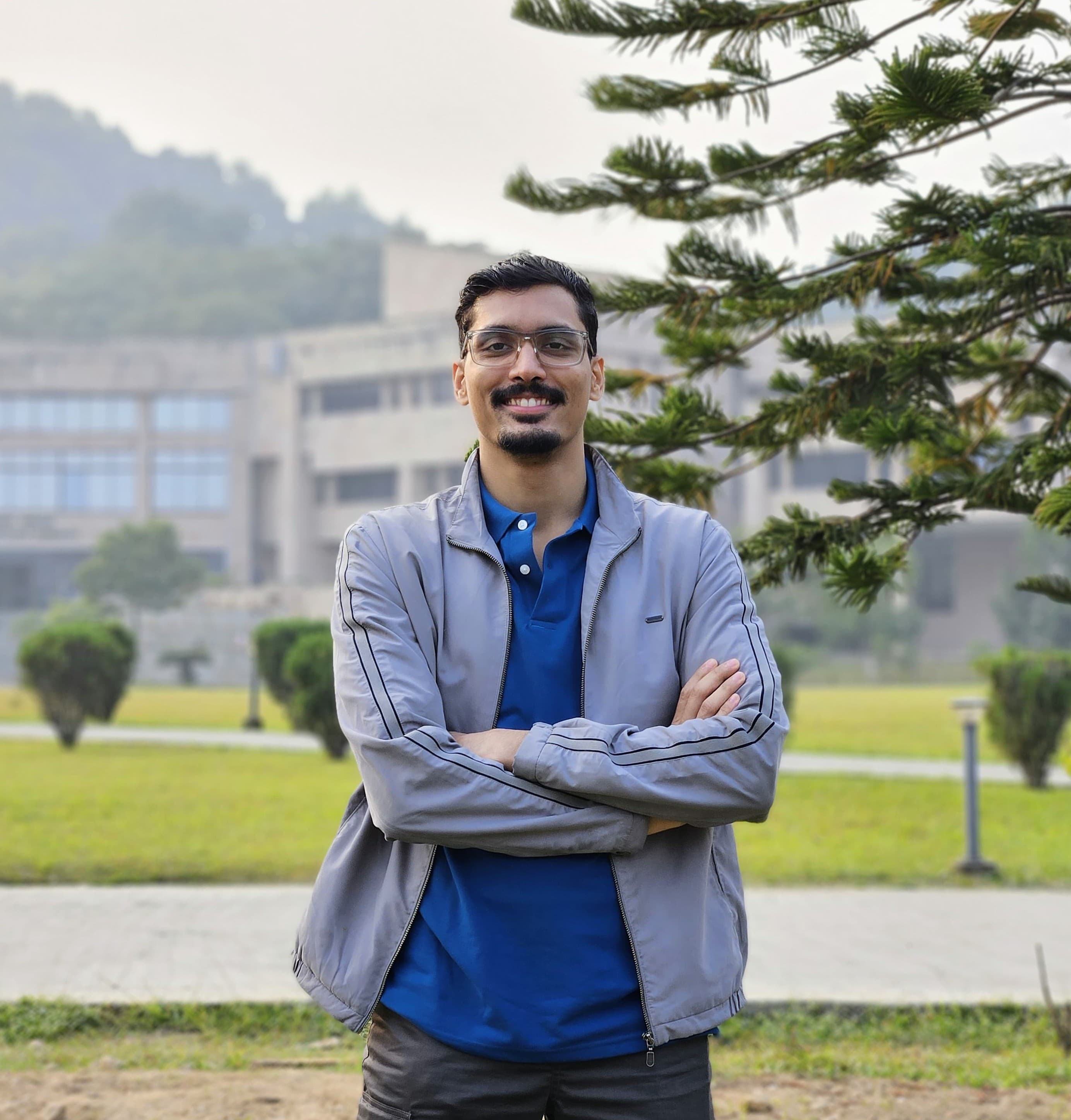
Akshay Daydar is a PhD candidate in the Department of Mechanical Engineering at the Indian Institute of Technology Guwahati (IIT Guwahati). His research interests include biomedical image processing, deep learning, and human gait analysis. Prior to joining IIT Guwahati, Akshay completed his postgraduate and undergraduate studies at the National Institute of Technology Warangal (NITW) and Government College of Engineering, Amravati (MH) respectively. He has also interned at BHEL Corporate R&D Hyderabad for his postgraduation project. Besides his academic pursuits, he enjoys photography, sketching, and traveling.
Contact Details
 LinkedIn
 Google Scholar
 GitHub
Downloads
July 2019 - May 2020
Intern at Department of Experimental Mechanics and Virtual Reality (EMV), R&D Hyderabad
Supervisors: Prof. N. Selvaraj (ME, NITW) and Mr. Vimal Kumar Gaurav (Senior Engineer, BHEL)
Project Title: Predictive Modelling of the Steam turbine generator unit and critical parameters Identification for rotor vibration and bearing problems.
Description: This project used data-driven modeling to predict steam turbine and generator outputs and identify critical parameters for rotor vibration and bearing issues. Techniques included ANN, RNN, Decision Trees, and Random Forests with feature selection via PCA and Pearson correlation. The final model suggested critical parameters and included a GUI for visualization and dynamic analysis.
Keywords: Predictive Modelling | Statistical Data Analysis | Classical Machine Learning Models | Explainability Methods. Software: R (Interfaces: R studio, R-Shiny).
Publication:
1. Vimal Kumar Gaurav, Daydar Akshay, N. Selvaraj, Krishnaiah Jallu, K. Ramakrishna. "Comparison of Predictive Modeling Techniques for Determining Power Output in The Thermal Power Plant", International conference on machine learning and data Analytics 2020 (Best Paper Award).
September 2020 - Ongoing
Supervisors: Prof. S. Kanagaraj (ME), Prof. Arijit Sur (CSE)
Project Title: From Images to Insights: Deep Learning Approaches for Knee Osteoarthritis Analysis from Radiological and Biomechanical Data.
Description: The research focused on the development of automated tools for the comprehensive analysis of Knee Osteoarthritis (KOA). The key objectives include: 1. Deep Learning-based classification of KOA from radiological data, 2. Deep Learning-based segmentation of tibio-femoral tissues involved in its pathophysiology, 3. Deep Learning-based extraction and analysis of biomechanical parameters from KOA subjects, and 4. Statistical technique-based establishment of correlations between radiological variables such as JSW and biomechanical parameters for KOA. 5. Deep Learning-based establishment of a multimodal radiology report generation from radiological and biomechanical data. The entire workflow is automated using deep learning techniques, with medical validation provided by clinical experts from colaborator of study, GNRC hospital Guwahati. This interdisciplinary research lies at the intersection of deep learning, biomechanics, and clinical sciences. The radiological data used in the study include X-ray and MRI scans, while biomechanical data are collected from the Gait and Motion Analysis Lab at IIT Guwahati. In summary, the study delivered a novel multimodal framework that integrates radiological and biomechanical data, enabling accurate classification, segmentation and radiology report generation. The study also focused on establishing a radiological–biomechanical correlation matrix through non-parametric statistical analysis. Overall, The multi-directional approach for revealing intrinsic interdependence between radiolgical and biomechanical diagnostic modalities for a deeper understanding of KOA.
Keywords: Semantic Segmentation | Multiclass Classification | Multilabel Classification | Gait Data Collection | Medical Context Aware Deep Learning Models. Software: Python (Interfaces: PyTorch, Monai, TensorFlow).
Teaching Assistant for Deep Learning (CS590) and Mechanical Workshop (ME101)
Technical Assistant for Universal Testing Machine (UTM) – 5KN at Central Instrument Facility at IITG
Departmental Placement Representative (DPR) for Ph.D. in 2023-24.
Volunteered and conducted 1 lecture and 1 hands-on session at Winter School on Deep Learning for Vision and Language Modelling 2025, IITG
Volunteered and conducted 1 lecture and 1 hands-on session at Summer School on Language and Vision Modelling (LAVA 25), IITG
Reviewer of: